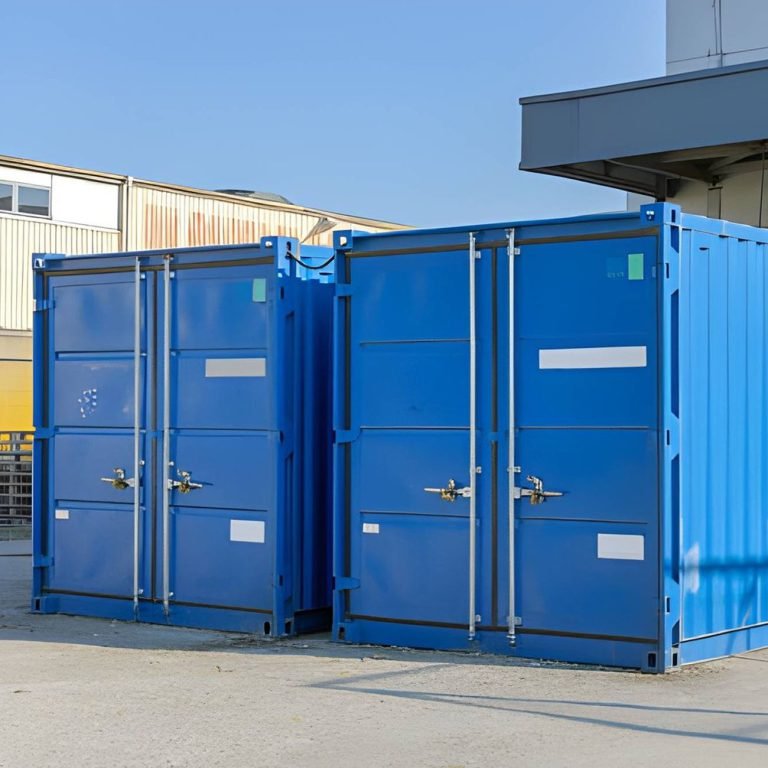
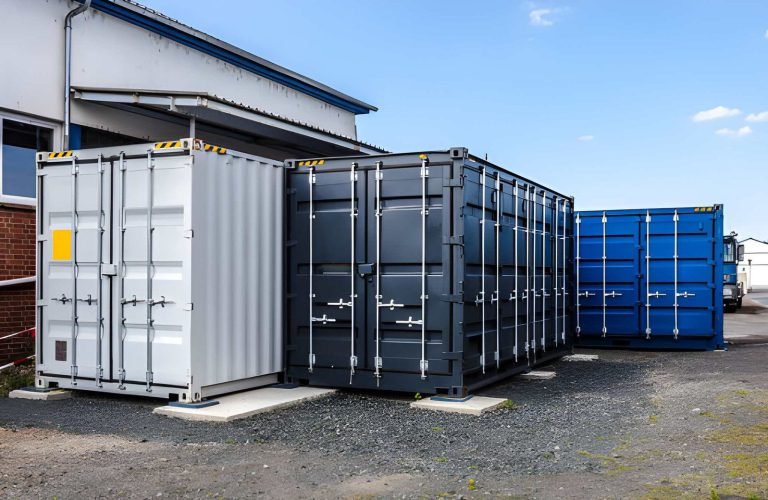
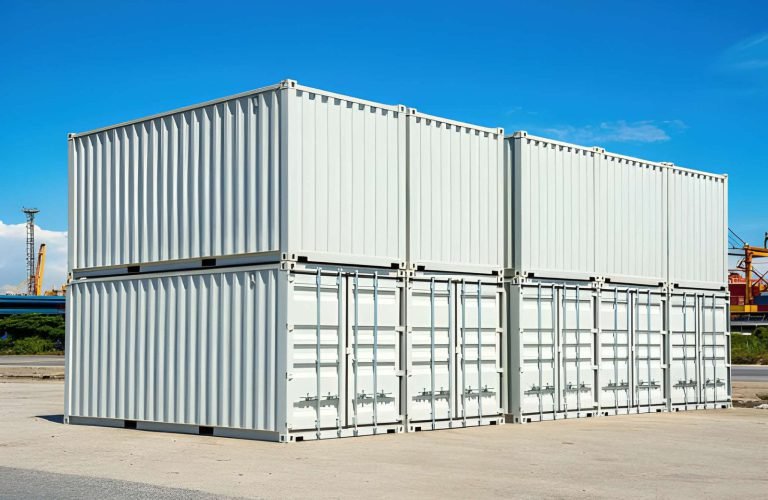
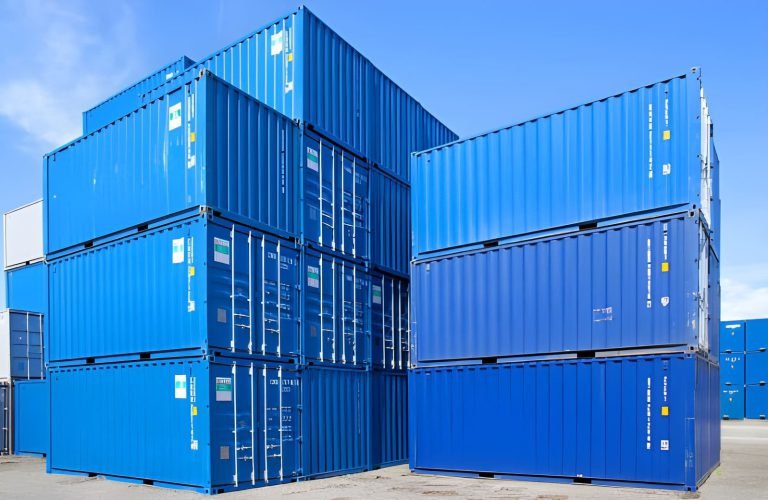
The 20ft and the 40ft are the two sizes that make up most of the market, and the choice between them comes down to three things: how much you need to store, whether your site can physically take the larger unit, and how the cost per cubic foot works out. Getting this wrong in either direction is expensive, so it is worth a few minutes of arithmetic.
What each size actually gives you
Both standard sizes share the same external width of 8ft and the same 8ft 6in height. Only the length changes, which makes the comparison unusually clean.
- 20ft standard: roughly 160 sq ft of floor and about 1,170 cubic feet of internal volume. Comparable to a single-car garage.
- 40ft standard: roughly 320 sq ft of floor and about 2,390 cubic feet. Effectively two 20ft units end to end.
Figures vary slightly between manufacturers and with the condition of the floor, so treat them as planning numbers rather than guarantees. If height is your constraint rather than length, look at high cube units, which add a foot of interior headroom.
The cost argument favours the 40ft
A 40ft container is not twice the price of a 20ft. Manufacturing, handling and transport costs do not scale linearly with length, so you generally get roughly double the space for considerably less than double the outlay. Delivery reinforces this: our freight is a flat $450 per order regardless of size, so two separate 20ft deliveries cost more in freight than one 40ft delivery.
On pure cost per cubic foot, the 40ft usually wins. That is only relevant if you can get one onto your site.
The site argument often favours the 20ft
A 40ft unit needs a long, straight, firm run for the truck to tilt and slide it off — in practice a clear stretch of roughly 80 feet plus room for the tractor. Many yards, driveways and back lots simply do not have that. A 20ft unit is far more forgiving, and two 20ft containers can be placed in positions a single 40ft never could.
Choose 20ft when
- Access is tight, or the route involves 90-degree turns
- You want the option of moving the unit later with common equipment
- You need storage split across two locations or two purposes
- You are storing dense goods and will run out of weight before you run out of space
Choose 40ft when
- You have open, firm ground and a straight approach
- You are storing bulky, light goods where volume is the limit
- You want the lowest cost per cubic foot
- You are planning a conversion that needs a long uninterrupted span
Do not forget the smaller sizes
If a 20ft still feels oversized, the shorter units are genuinely useful rather than a novelty. 10ft containers fit where nothing else will and suit tool stores, site security and small yards, while 12ft containers split the difference. At the other end, 30ft cut-down units cover the gap when a 40ft is too long for the plot.
Next steps
Browse the 20ft range and the 40ft range side by side, then check our container grades guide so you are comparing like with like on condition as well as size. The full buyer’s guide walks through door options and site preparation. If you would rather talk it through, call +1 430 280 1063.