Most delivery problems are not truck problems. They are site problems that nobody checked until the driver was already at the gate. A loaded 20ft container and the trailer under it need a surprising amount of room, and once a tilt-bed starts to unload there is very little scope to adjust. Half an hour of preparation saves a wasted delivery slot and a redelivery charge.
Start with the ground
Containers do not need a foundation, but they do need a firm, reasonably level surface that will not sink under concentrated load. The weight rests on the four corner castings, so all the mass is carried on four small points rather than spread along the base.
- Compacted gravel, crushed stone, concrete or asphalt all work well.
- Soft ground, fresh topsoil, sand and recently disturbed fill do not — they rut under the truck and settle under the corners.
- Set railroad ties, concrete pads or blocks under the four corners if you are placing on soil. This also lifts the floor clear of standing water.
- Aim for level. A container that sits twisted will bind its doors, and door problems on a used unit are usually a levelling problem rather than a container fault.
If the ground is questionable after rain, move the delivery rather than risk a truck bogging down in your yard.
Check the access route, not just the space
The container has to reach the spot, which means the whole route matters: the gate width, the turning circle, the surface, and anything overhanging it.
Clearances to measure
- Length: a tilt-bed needs a clear straight run roughly twice the container length to tilt and slide the unit off. For a 40ft unit that is a long stretch of open ground.
- Width: allow about 12 feet of clear width along the route and at the placement point.
- Height: at least 16 feet of overhead clearance. Power lines, tree limbs, signage, canopies and building overhangs are the usual culprits.
- Gates and corners: a rigid truck and trailer cannot pivot like a car. Tight 90-degree turns between buildings often rule out a site entirely.
Decide where the doors face before the truck arrives
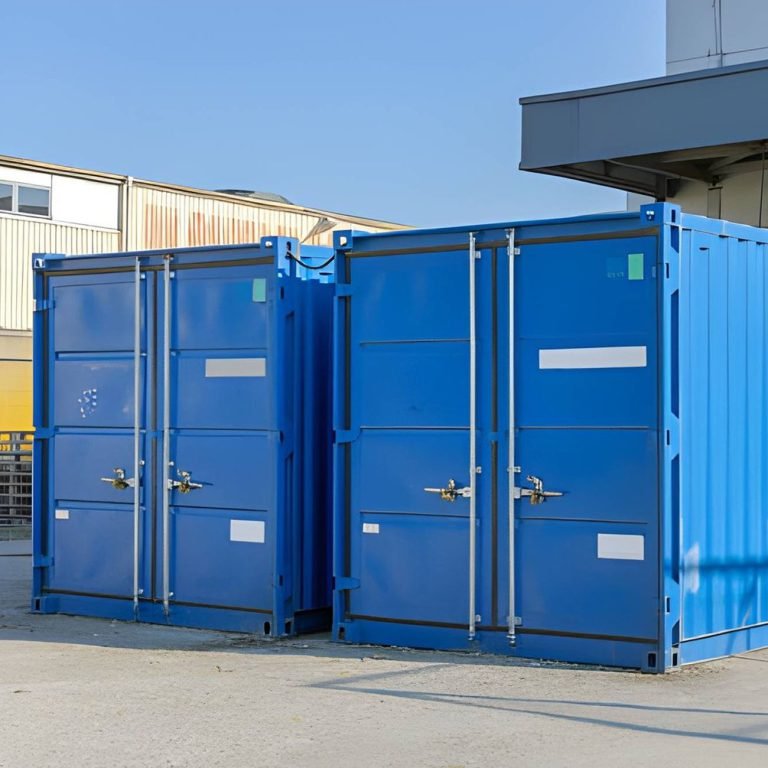
This is the single most common regret. The container comes off the trailer in one orientation, and turning it afterwards means bringing equipment back. Think about how you will actually use it: which way you will drive up to load, whether you want the doors sheltered from prevailing weather, and whether you need room to swing the doors fully open. Standard cargo doors need several feet of clear space in front of them.
If door access is genuinely awkward on your site, that is an argument for a different door configuration rather than a different spot. Open side and double-door 20ft containers and 40ft tunnel and side-door units exist precisely for constrained yards.
Have someone on site
Somebody who can make decisions should be present at delivery. Drivers will not guess where a container should go, and they are not responsible for judging whether your ground will hold. Take the opportunity to walk the unit as soon as it is down: check the doors open and close, look along the roof and floor, and note anything that does not match what you ordered. Our refund and returns policy gives a seven-day inspection window from delivery, and that inspection is much easier while the truck is still in sight.
Practical checklist
- Firm, level ground and corner supports if needed
- Route measured for length, width and overhead clearance
- Gates unlocked, vehicles and skips moved out of the way
- Door orientation agreed and marked on the ground
- Someone on site with authority to sign and inspect
Delivery from our Greenville, Texas depot is a flat $450 per order anywhere in the continental US — the details are in our shipping policy. If you are unsure whether your site will take a 40ft unit, call +1 430 280 1063 or email info@marinercontainers.com before you order and we will talk it through. You can also browse the current inventory if you have not settled on a size yet.